
The LOGIC Home: How a More Attainable GO Logic Home Came to Life
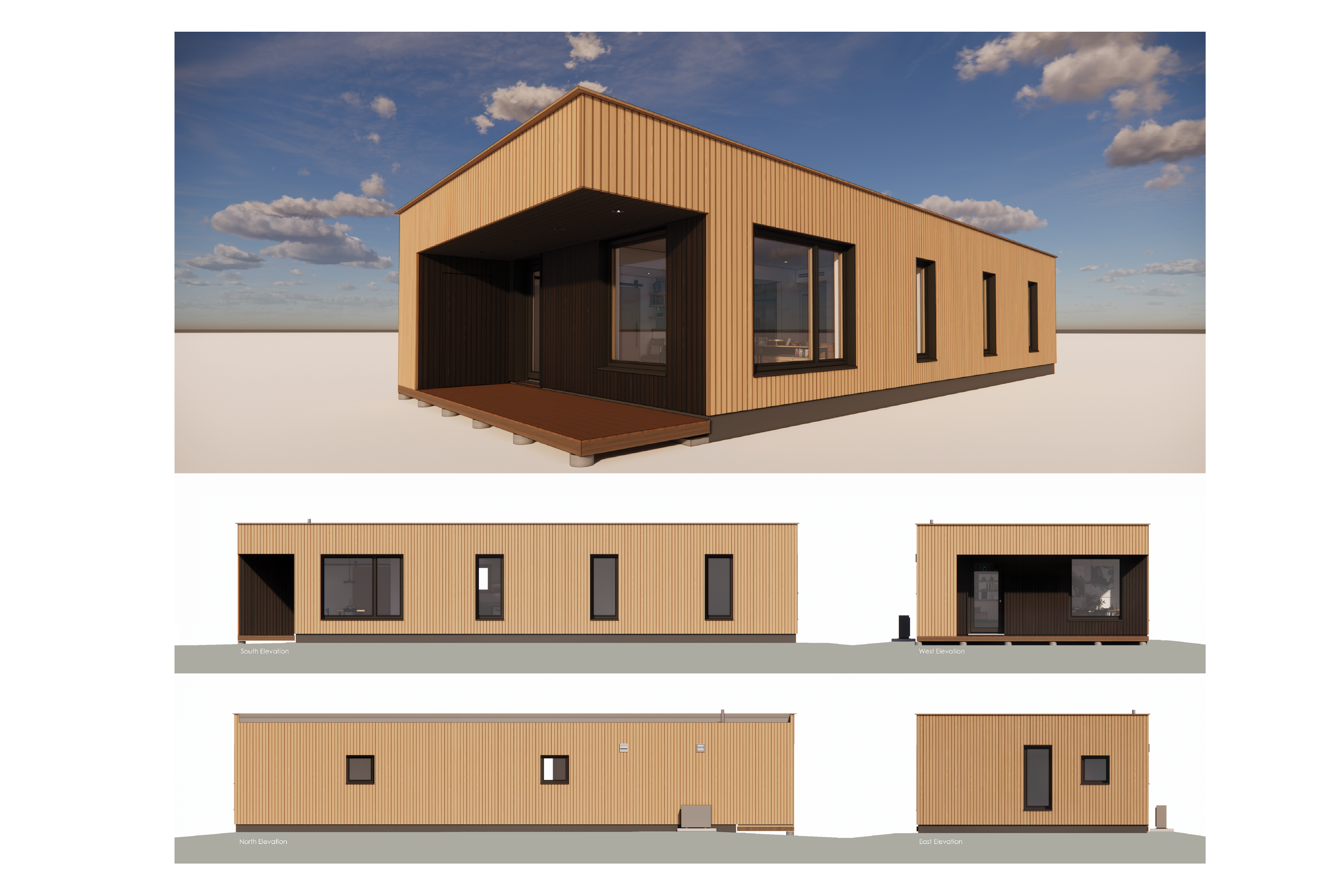
In early 2025, having just settled into our new shop, a perennial question at GO Logic resurfaced with a passion.
Could we design a home that feels like a GO Logic home, performs like a GO Logic home, but is more attainable?
Our crew began clamoring for homes 100% designed for panelization — no one-off surprises, no site-required workarounds, only total clarity from start to finish. That clarity should bring down the price. The LOGIC Home grew out of that desire to create a GO Logic home that stayed true to our standards, but even smarter, more attainable.
What follows is the story of how it came together: what we changed, where we refused to compromise, and why we chose to invest in building something new from the ground up.
From“10-Panel House” to the LOGIC Home
The earliest version of this idea was known as “the 10-panel house.”
The thought experiment was simple: Determine the minimum number of panels needed to create a fully-functioning, low-maintenance family home. Fewer panels would mean less handling, faster installs, less complexity, resulting in a lower cost to build. This could bring GO Logic quality homes within reach of younger families, retirees on a fixed income, and those who we currently couldn’t serve.
Inside the company, the phrase “low-cost house” came up for a while. But it never sat right. This is not a low-cost house. It is carefully designed, high-performance, and still a significant investment. The real goal was attainability: a house that is more accessible than a fully custom home, or a customized GO Home, while staying true to our standards.
That is why, as the design matured, the name LOGIC Home emerged and stuck. It is a logical outcome combining panelization, performance, and real-world budgets, bringing them together in a single, coherent model. (But don't worry, we have more designs up our sleeves for this line—larger and smaller LOGIC Homes coming soon.)
A Grassroots Idea Finds a Structure
Before the LOGIC Home became a formal project, informal conversations kept happening around the proverbial water cooler.
People were asking: Really…why can’t we do this for a lot less?
Housing affordability is a real crisis. And we didn’t want the kind of homes we build to feel out of reach. From a financial perspective, Alan (GO Logic's principal), who lives and breathes the P&L, knew some of the early numbers people were floating wouldn’t hold up.
Rather than shutting the idea down, though, we created a structured path for channeling passion inside GO Logic—a new program we call Idea Teams. Anyone in the company can now propose a project, propose a small team, lay out a budget of hours and materials, and present a case for why it should move forward.
The early “10-Panel House” concept was one of those proposals. It was not a side conversation anymore. It was a funded, time-bound project with a clear mandate: optimize a GO Logic home for panelization and cost, without compromising the core of who we are and what we deliver.
A Realistic Goal: 20 Percent Less, Not Half the Price
Internally, there were big hopes at the beginning. Some people genuinely wondered if we could cut the total cost of a home in half.
Alan set a different target: a 20 percent reduction based off the comparable customized GO home.
Roughly speaking, we expected that savings to come from two places
10 percent from design simplification
A simpler form, fewer panel types, tighter finish + option choices
10 percent from efficient fabrication
Panels optimized for manufacturing would be built faster and cost less
In addition to these core savings, it also turns out there is a significant cost savings on the front end in design and engineering. Having designed the house already, we wouldn’t be making any changes, and literally reuse the drawing set, saving thousands of dollars in design fees. Since the structural engineer would already have specified the structure, they’d just need to confirm a few things about the site and issue approval.
One additional but necessary step in pre-fab construction is to create a 3-dimensional building model that describes every little piece of the structural shell of the house. As with design and engineering, this would be done once and reused for every LOGIC Home going forward.
Factoring all of this in, depending on the home model and various factors, the reduction in upfront design costs would put the overall savings well above 20% from a customized GO Home.
But we would be clear:
This will be more attainable, not “cheap”
We will simplify, but we will not hollow out the performance or the experience
Designing for Panelization From the First Sketch
Many of our existing designs were adapted to panelization after the fact. The LOGIC Home is different. It was conceived from day one as a panelized object.
The walls are just six large panels:
Two long side walls at the maximum length we can build in our shop, about 26 feet, and
Two end walls at about 24 feet wide
That simplicity means:
Fewer seams to manage
Faster, more predictable production in the shop
Cleaner setup and fewer crane picks on site
The roof went through a similar rethink. With the LOGIC Home, we designed a flat, panelized roof assembly that, while not 'New England traditional,' is the most efficient way to enclose space. Efficiency is the goal.
The target is clear:
Typical installs take about seven days
The LOGIC Home should take four days on site (fully enclosed with a finished roof)
A Very Pretty Box
The LOGIC Home looks like a box with a porch, and we say that with affection. That simple volume is doing a lot of work:
It minimizes exterior surface area relative to interior volume
It keeps the structure straightforward, reducing the need for expensive engineered lumber
It makes panelization clean and repeatable
Worth noting. This design has:
A flat roof. This is the most economical way to enclose space, and a natural fit for panelization.
A cantilevered porch corner. Eliminating the corner post removed a footing, reduced field coordination, and simplified the panel design. It also opened up the space visually, creating a lighter, more welcoming entry that softens the box and adds a modern lift.
Optimized openings. We pulled windows up off the floor and kept them within panel-friendly zones, avoiding floor-to-ceiling glass that requires site installation. The result still delivers the bright, airy quality our homes are known for, without compromising light or simplicity.
Finishes. No downgrades here. The flooring, hardware, fixtures, and appliances are all the same as in our GO Home line, keeping the dependability, experience and visual quality fully intact.
From the curb, it has a modern, almost container-like clarity. From the inside, it is more generous than the 1,418 square foot footprint suggests. Three bedrooms, two full baths, a generous kitchen, and enough flexibility to work for a family or a couple wanting a home office and guest room.
Where We Refused to Compromise
During the process, we kept coming back to two core questions. Does it still perform like a GO Home? Does it still feel like a GO Home?
That led to a few non-negotiables:
High-performance envelope. The LOGIC Home is designed to hit our typical Passive House level performance targets once modeling is complete.
Triple-glazed wood windows. We install the same German tilt-and-turn wood/aluminum-clad units as are standard on the GO Home line.
Mechanical systems. We kept the same level of mechanical performance and efficiency. Comfort, air quality, and resilience, including the ability to ride out a winter power outage, were not on the table for cutting.
Finish quality and aesthetic. The finishes and overall design language are consistent with our other homes. We narrowed options and removed customization, but we did not downgrade materials.
What we gave up:
Full customization
Floor-to-ceiling windows
Certain one-off structural and aesthetic elements that complicate panelization
What we gained:
A simpler, faster, more predictable build
A meaningful reduction in cost
A model we can refine and repeat, a more attainable GO Logic home, that doesn’t water down our brand
What Comes Next
The first LOGIC Home will tell us a lot: where the bottlenecks are, which details need refinement, and how closely our cost and schedule targets match reality.
We already know there is demand for variants, such as a smaller, roughly 900-square-foot two-bedroom version. Over time, we expect a small family of LOGIC Home models to emerge: tightly designed, panel-optimized homes that keep GO Logic’s performance and design values intact while reaching a broader slice of buyers.
For now, the LOGIC Home has already confirmed for us that we love:
Listening to our team when they ask hard questions about access and price
Trusting them to take on a complex challenge and solve it
Proving that “more attainable” does not have to mean “lesser”. It can just mean smarter
If you are a homeowner, general contractor, or architect who wants to be part of that first wave of LOGIC Homes, we would love to talk. You can start by filling out our short LOGIC Home inquiry form here:
