
Idea Teams: How We Turn Ideas into Projects and Projects into Real Change
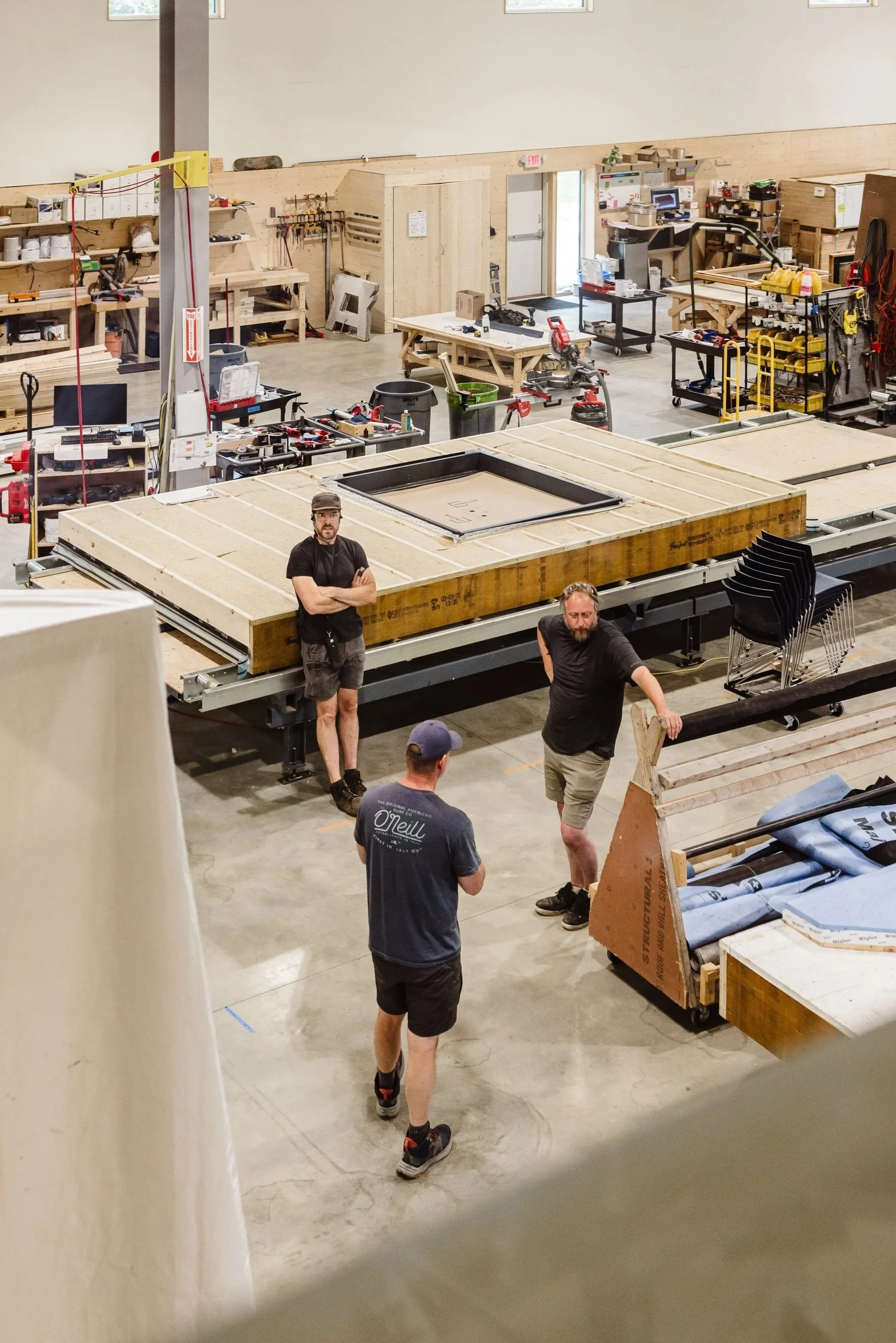
Many companies have people with strong opinions about how things should work. Not all companies give those people a structured way to test their ideas.
In January 2025, we launched a simple experiment at GO Logic called Idea Teams. We invited anyone on staff to propose a project, build a small team, and ask for a budget of time and resources. The only catch was that it had to advance our core goals as a company.
A year later, that experiment has produced a more attainable, panel-optimized home design, a new onboarding system in our shop, deeper understanding company-wide of material toxicity, embodied carbon, BIM (Building Information Modeling) and DfMA (Design for Manufacturing), along with a forthcoming guide for outside architects who want to collaborate on panelized projects with us.
This is how Idea Teams work, what they produced, and what we might change next time.
Why We Created Idea Teams
The honest origin story is one that came from energy bubbling up in different corners of the company.
In the months before Idea Teams we born, our new shop and added capacity led people at GO Logic to increasingly ask big questions. Are the types of homes we build for others, something everyone in our company could afford? How we could do a better job with efficiency, materials and training? Are there smarter ways to organize our work?
Some of those conversations were hopeful and imaginative. Some were more pointed. Taken together, they were a signal that people cared deeply about the work and saw opportunities for improvement from their various vantage points.
Instead of asking people to stay in their lane, we wanted to channel that energy. The question became:
How do we give people who are passionate about a problem, a constructive, supported way to work on it, without letting everything else grind to a halt?
Idea Teams were our answer.
How Idea Teams Work
The structure is intentionally lightweight, but not casual.
Once we announced the program, we opened the door to the entire company:
If you have identified a problem or opportunity at GO Logic
If you can articulate how addressing it will move us toward our reaching our goals
You can propose an Idea Team
Each proposal comes in through a simple application that asks for:
The problem or opportunity you want to tackle
Why it matters, and how it connects to our mission and yearly goals
Who you'd like to see be on the team
How much time you expect to need, in hours
Any budget for materials, software, or outside support
What you plan to produce at the end, for example a guide, an SOP, a new system, a report, or a prototype
Those proposals go to the company's strategic Core Team for review. To keep things fair and consistent, we created a rubric in a shared spreadsheet. Each idea gets scored along multiple dimensions on a one to five scale, such as:
Alignment with our strategic goals
Potential impact
Feasibility within the proposed time and budget
Likely benefit to multiple parts of the company, not just one person or team
Some proposals move forward with very little change. Others get sent back with questions or requests to narrow the scope. A few do not move forward because they are simply not a good fit for GO Logic in the near term.
For example, in our first round we saw proposals to:
Build an in house cabinet shop
Launch an eco village
Both of those ideas were imaginative, but they did not align closely enough with our core business, our capacity, or our immediate goals. They became helpful conversations, things to keep in mind, but not active projects.
The proposals that did move forward became our first Idea Teams.
The Projects That Made It
In the first cycle, we approved four or five Idea Teams that each focused on a different friction point or opportunity in the business.
1. The LOGIC Home
This team took on one of the biggest questions being asked inside the company:
How do we design a GO Logic home that is meaningfully more attainable, without downgrading performance or hollowing out the experience of living in it?
That work eventually became the LOGIC Home, a panel-optimized, three bedroom, two bath home that is designed to be about 20 percent less expensive than a comparable custom GO Logic home. It is still very much a GO Logic house in feel and performance, but it is designed and built from the start to maximize efficiency, panelization and speed.
2. Toxicity and Materials
Another team looked hard at what is in the products we use, both for the people who live in our homes and for the people who build them.
They cataloged materials, researched toxicity and health implications, and then presented their findings in a clear, engaging way at a company learning session. Their work is now available to all employees, and informing decisions and internal conversations about what healthy materials actually mean in practice.
3. Shop Onboarding and Training
If you bring a new carpenter into the shop, how do you know they are ready to use tools safely and consistently with our standards?
Led by Jenna, this Idea Team developed a more structured onboarding and training process for incoming shop staff. It clarifies expectations, covers critical safety and skills topics, and gives both the new hire and their supervisor a clearer path through those first weeks and months.
That framework is now part of our normal operations and will likely inspire similar onboarding work for other parts of the company.
4. Architect Design Guide
As more outside architects express interest in working with our panel system, we saw that we did not yet have a clear, comprehensive guide to help them succeed.
Alex took on the task of drafting an architect design guide. The guide is still in development, and serving to clarify for everyonew in the compnay as well, just how different it is to design for panelization from the start, rather than retrofit a design after the fact. Once complete, it will give outside designers a way to plug into our system seamlessly and without any surprises.
5. Carbon Accounting and Whole House LCA
A fifth team is focused on carbon accounting and lifecycle assessment at the whole house level. They began mapping the embodied carbon of our assemblies and materials, and will present their progress at an upcoming learning session. Their work is already shaping discussions around foundations, insulation choices, and how we compare different assemblies with regard to climate impact.
6. Neurodiversity in the Workplace
A sixth team researched and shared all kinds of ways that neurodiversity on our team adds insight and value to the client, the project and the community here at GO Logic.
Taken together, these projects covered a wide spectrum: design, health, safety, collaboration, and climate. Importantly, the energy to really delve into ways to improve the company and its impact, was not something management needed to drum up. It was just looking for an outlet.
Learning Sessions as Stage and Deadline
A key part of making Idea Teams real was giving them a place to share their work.
Once a month, GO Logic holds a Learning Session. It is a 60-90 minute, all company meeting where we focus on a single topic. Historically, that has ranged from building science and Passive House certification to goal-setting, anti racist training, and all kinds of other cultural conversations.
With Idea Teams in place, Learning Sessions also became:
A stage, where teams present their findings and proposals to their peers, and
A deadline, something concrete to work toward
Each Idea Team was given time on a future Learning Session agenda. That promise of time with the whole company, encouraged teams to synthesize their work, anticipate questions, and think about how to communicate their ideas clearly.
It also created a series of leadership opportunities. People who do not typically present in front of the whole company had a chance to do exactly that, with support.
What Worked Really Well
Looking back at the first year, several things stand out as clear wins.
Real issues, not side projects
Teams chose topics that genuinely mattered to them and to the company. These were not hypothetical exercises. They were direct responses to friction or opportunity in our day to day work.
Tangible outputs
Each Idea Team is adding value that now exists in the business: a new product in the LOGIC Home, a shop onboarding framework, better building material literacy, improved carbon accounting and DfMA systems understanding, and an Architect Guide.
A perfect hit rate on usefulness
From Alan’s perspective, every approved Idea Team delivered something that made the company stronger. There were no projects that simply fizzled and disappeared.
Leadership development
People led meetings, managed small budgets, coordinated across roles, and stood up to present in learning sessions. Those experiences matter, especially in a small company.
In short, Idea Teams did what we hoped they would do. They turned ideas and concerns into structured projects, and projects into durable improvements.
Where the Process Fell Short
The first round was not perfect.
The front end of the process was quite structured. Proposals were thoughtful, the rubric helped with selection, and the link to company goals was clear.
The back end was looser:
Check ins were mostly informal, often relying on individuals to seek out feedback
Deadlines were tied to Learning Sessions that sometimes shifted in the calendar
Expectations for interim updates were not always explicit
In practice, that meant some projects took longer than expected, and it was not always obvious to everyone where each Idea Team stood at a given moment.
None of that undermined the value of the work, but it did reveal opportunities to improve the process.
What We Are Changing for Round Two
Based on what we learned, the next round of Idea Teams will likely include:
Clearer timelines from the start
When a proposal is approved, it will come with a defined presentation month at a learning session. That will help teams pace their work and help the rest of the company know when to expect updates.
More explicit check ins
Rather than relying only on ad hoc conversations, each team will have planned touch points with a clearly identified Lead and support avenues.
The goal is not to weigh Idea Teams down with bureaucracy. It is to create just enough structure that good projects and motivated problem-solvers have the support and visibility they need to finish well.
Why This Matters Beyond GO Logic
On the surface, Idea Teams are an internal process story. But the pattern is simple enough that other firms could adapt it.
The core ingredients are:
A clear set of company goals
An open invitation for people to propose work that advances those goals
A basic application that asks for a problem statement, a team, a timeline, a budget, and a deliverable
A transparent way to evaluate proposals
A regular forum where people share what they have learned
In return, you get:
Better systems and products
People who feel heard and trusted, and recognized for their initiative
A culture where energy and frustration have a useful outlet/channel
For GO Logic, Idea Teams have already contributed to a more attainable home model, stronger onboarding, better information about our materials, carbon and systems, and a more thoughtful way of working with outside architects.
Most importantly, they have given our staff a real way to shape the future of the company.
If you are curious how one of these projects looks in practice, you can read the story of the LOGIC Home, our new panel-optimized, more attainable home, in our journal.
Want to Take the Next Step With Us?
Interested in working with a team that operates this way, where good ideas have a real path to become real projects?
Explore opportunities here: Work with GO Logic (there is currently an architect position available)
Curious what it looks like to build with us, or to bring a project into our panelized system?
Start a conversation here:
